
Book Report 8/6/25
Pamela Dean, Ursula K. Le Guin

Hey gang, I have been phasing out the book reports because they are always my worst performing posts and seem to produce my worst writing and because it’s better to integrate my reading into my essays, which is how you get me quoting Rebecca Solnit while writing about Metal Gear Solid. But there are always going to be books I want to tell you about even though I can’t do anything with them in a larger discussion. Between my day job and a trip to see family and raising an extremely energetic almost-three-year-old I have had neither the time nor bandwidth to write lately, so this also feels like a good way to shake the cobwebs out and try to get back to a regular schedule. Hope you enjoy, there’s better stuff in the pipeline I promise. Obligatory disclosure that the links on the titles are my affiliate links so if you use them to buy the book I get a couple bucks.
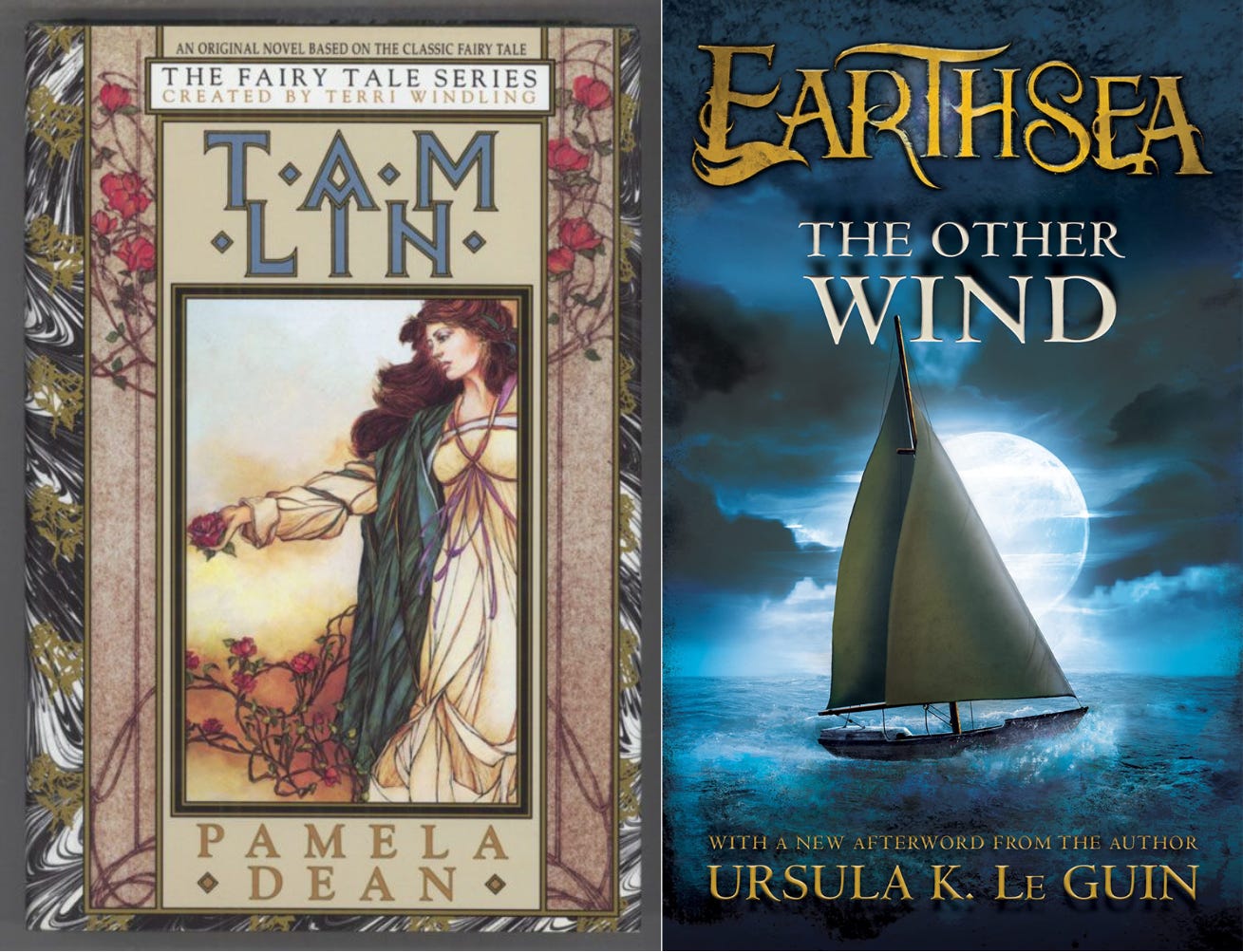
Tam Lin, Pamela Dean, 1991
It’s the early 70s and Janet Carter is an incoming freshman at Blackstock College. She’s going to be an English major. Her advisor asks “Are you sure you don’t want to do Classics?” She and her roommates Molly and Tina meet some boys—Nick, Robin, and Thomas—who are Classics majors. They ask her, “Are you sure you don’t want to do Classics?” The Classics department functions like a cult centered around the raven-haired Professor Medeous and seemingly everyone in it is very beautiful and otherworldly. Also Janet’s dorm might be haunted by the ghost of a young woman who has a penchant for throwing her old books out the window, particularly her Liddell and Scott Greek lexicon.
Tam Lin is ostensibly a fantasy novel but in practice it is a sustained portrait of the everyday life of a student at a small liberal-arts college. Dean remembers clearly what those first weeks of college are like—how friend groups coalesce, how young people adjust to being away from home, how giddily earnest and annoying freshman are after reading one (1) Shakespeare play. She gets the rhythm and the representative decisions of campus life, where it’s a matter of major dispute which dining hall to frequent. Dean never fails to specify what classes Janet is taking in a given quarter. The one aspect of college life completely absent from this book is any depiction of partying; as far as we see Janet does her homework and goes to bed on time every night. I know Ancient Greek is a lot of work but I can attest from personal experience you can learn it while also being a degenerate on the weekends.
So the girls and the boys pair off: Janet with Nick, Molly with Robin, and Tina with Thomas. Janet’s relationship with Nick is intellectually stimulating—he can quote her beloved Keats right back at her—but from the start there’s a certain emotional remove. Quoting Keats back and forth is about all they can do. Janet feels blocked somehow from expressing her feelings and Nick doesn’t seem inclined to either. Robin is much the same way, communicating almost exclusively in Shakespeare lines and holding an ironic distance from everything happening around him. Thomas is much more engaged, both with the world and his emotional life. As the book goes on one starts to notice that Thomas is getting a lot more space on the page than Nick and becoming more central to Janet’s life.
At least fifty percent of this book is given over to Janet’s freshman year followed by sophomore and junior year flying by in a flash. It’s a choice that tracks with my similar college experience—I can remember first semester freshman year with startling granularity whereas junior year is a total blur—but it gives the book an odd pace. While I enjoyed the depiction of college life, the book is fairly plotless until the final couple chapters and I had trouble sustaining my interest in the first half. Janet takes Ancient Greek from Professor Medeous, so central to the book’s mysteries, in her sophomore year but Dean leaves this setup puzzlingly undramatized. We’re told Medeous is imposing in class but gentle with even the hopeless cases. Okay. Compare to the fuller scenes with Janet’s freshman English professor who does not figure in the plot at all.
Anyway, I liked this book. It’s a sweet love letter to college. I did however catch one glaring ERROR: at one point Janet is taking a physics class and Dean says she’s reading Newton’s De Rerum Natura—as we ALL know De Rerum Natura is Lucretius!! FRAUD ALERT!! If you have any interest in reading Tam Lin do not look at its Wikipedia page because it instantly spoils all the questions Dean holds off on answering until the very end.
The Other Wind, Ursula K. Le Guin, 2001
The final Earthsea book, which I found a mixed bag by Le Guin standards, very good by any other. Another fifteen years have passed since Ged and Arren went into the land of the dead to seal the hole in the world and Ged lost his power, another fifteen years since Ogion whispered in his final moments that all was changed. Ged and Tenar are in, probably, their sixties at this point. A healer mage named Alder comes seeking Ged’s counsel: his wife had previously died and now every night, in his dreams, he finds himself on that hillside looking at the wall of stones that separates the world of the living and the dead. His wife is there, on the other side, pleading for help—countless souls reach out to him over the wall, and he is pulled ever more toward them. Ged provides a stopgap solution—a kitten to keep him company at night and ground him in the living world—but he’s concerned about what the dreams portend so he sends him on, accompanied by Tenar and Tehanu, to Havnor for an audience with King Lebannen. Ged will stay home.
Seeing Lebannen is quite exciting. We haven’t seen him since he was Prince Arren traveling with Ged in The Farthest Shore. Now he, like Tenar and Tehanu, go by their true names, a mark of both immense status and humility. Lebannen is a just ruler and has risen to the challenges of kingship in all ways except one: he refuses to take a bride. Just arrived in port is a delegation from the Kargad Lands, the eastern archipelago of Tenar’s birth. The delegation has brought a Kargish princess, aka the daughter of the current most dominant warlord, and Lebannen is throwing an absolute fit at the prospect of being coerced into a political marriage. This felt like something of a cheat to me—instead of showing him as the man he has become, by framing his portrayal around this issue Le Guin essentially restages his journey from petulance to maturity we’ve seen once already.
So anyway, Alder’s situation turns out to be related to the plot point Le Guin introduced in Tehanu that long in the past dragons and humans were one people and one species before going their separate ways. I strongly dislike this idea. Earthsea’s “first trilogy” is pretty unequivocal that dragons are wholly other, they are magic itself in some sense, beings made of the True Speech, word as flesh. To say that humans were once that as well and gave it up for a lesser form of existence in exchange for the instrumental power the True Speech offered as magic, for me it cheapens the dragons in a really bummer way. And I don’t love Le Guin introducing such a glaring Garden of Eden fall from grace allegory into her world.
So our beautiful dragon girl Irian from “Dragonfly” in Tales from Earthsea shows up and we all pile in the boat, bringing along with them the Kargish princess, whose name is Seserakh, and head to Roke to deal with the situation. This part of the trip contains some of the best material in the book, particularly a scene of the four women hanging out in their shared cabin during a storm. By custom Seserakh only appears in public hidden under a red burqa type thing (vaguely Islamophobic) so Lebannen has no idea what she looks like or even how old she is. Well, she’s young and totally beautiful. After Tenar, Tehanu, and Irian encourage her to be bold, the next morning she appears on deck in a tunic with only a tiny, diaphanous veil over her eyes. She walks the length of the ship to Lebannen and looks him straight in the eye for the first time. It’s very sensual and romantic and instantly the reader loves this character they hardly know.
The resolution of the plot is quite beautiful and I’m pretty sure I cried (it’s been a couple months since I read it). Walls are one of Le Guin’s great images and metaphors—see the first sentence of The Dispossessed: “There was a wall.”—so to see what she does with it when she returns to it one last time was quite moving. This ending resolves a quibble I think many readers may have had since the earlier books, namely, why is Earthsea’s afterlife so grim? But in doing so it also kind of renders Ged’s great act of sacrifice in The Farthest Shore moot and pointless. There’s something here that smacks of gender—Ged’s masculine approach to fixing the afterlife was to oppose the problem with every ounce of his strength but when we send in Tenar, Tehanu, and Irian their action takes the form of an unweaving and weaving back together anew.
I really love Tenar and I was not unhappy to spend another book seeing through her eyes. But I also love Ged like few other characters in fiction. I can’t help but feel that Le Guin left him behind, having lost interest in the character. It’s okay she took away his magic but it feels like she took away his spark, his humor and zest for life. This was fine in Tehanu when he was grieving his newly lost magic, but I would have hoped he would have recovered himself. Instead he seems quite joyless, plodding through his tasks as a farmer without ever cracking a smile.
Maybe I’m wrong. I know I have one story left about Ged, “Firelight,” which was published shortly after Le Guin’s death in 2018. My understanding is that it concerns Ged in his own final days. I find it very moving she returned to him one last time after nearly fifty years together. I’m saving it for when I really need it.
Man, I loved Tam Lin! It's so weird and meandering and almost entirely uninteresting in sustaining a plot or maintaining suspense and that's part of why I love it. But it is totally bizarre on that front!
If you liked Tam Lin, I think you’d enjoy her Secret Country trilogy too :)